


A trade show banner has one job. It has to be read from across an exhibit hall by somebody who is walking past and is not looking for you.
Four formats do most of that work, and DVC Signs lists all four under tradeshow and event signage: retractable banners, ceiling and rafter-hung banners, tabletop displays with table skirts, and promotional flags. Picking between them is mostly a question of where the banner has to live. Picking what it is printed on is a question of whether the room is indoors, outdoors, or watched by a fire marshal. This guide takes those two decisions in that order, using the materials DVC Signs describes in its own materials guide and the rules the Tampa Convention Center publishes for exhibitors.
- DVC Signs lists four trade show banner formats: retractable banners, ceiling and rafter-hung banners, tabletop displays with table skirts, and promotional flags.
- Its vinyl banner material is tear and fade resistant and rated for indoor or outdoor use. DVC Signs states its banners are fire retardant.
- Wind mesh is the outdoor answer. The perforations let air pass through, which is what keeps the banner from tearing.
- At the Tampa Convention Center, banner hanging is an exclusive service. You cannot hang your own, and every banner is approved by the in-house contractor first.
- Signs there cannot be taped, nailed or screwed to walls, and cannot block exit signs, emergency exits, fire alarms or suppression equipment.
The four trade show banner formats, and what each one is for
DVC Signs lists four banner formats under tradeshow and event signage, and each one solves a different sightline problem. Work out which sightline you are buying before you work out anything else.
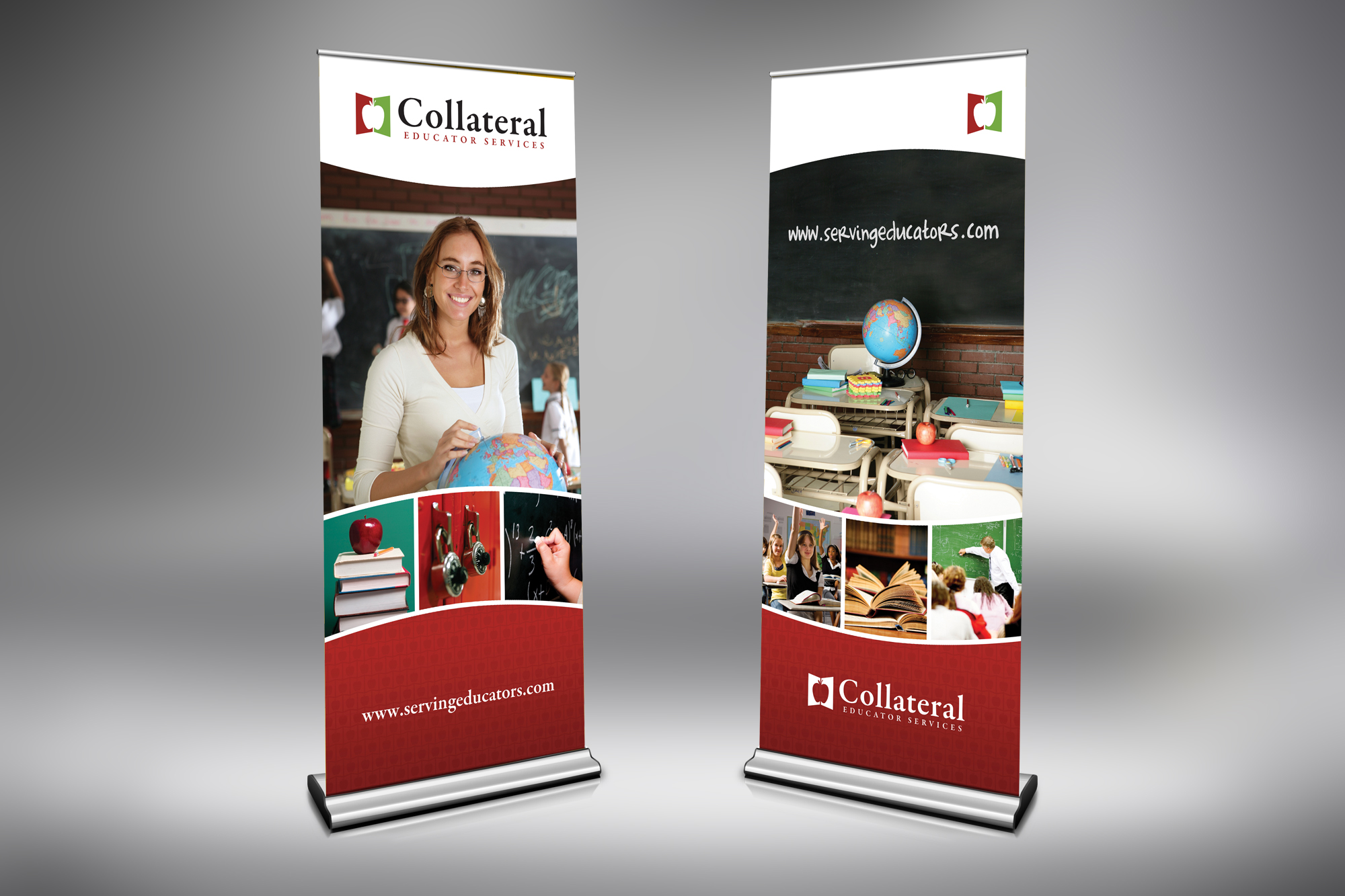
Retractable banners. The print rolls down into a weighted base and pulls up on a pole. It travels in a padded case, it sets up in about a minute, and nobody has to rig anything. The two stands photographed above are exactly that, built by DVC Signs for Collateral Educator Services. Retractables are what you stand beside the table or behind your shoulder, and they are the only format on this list that you can carry into a hall and put up yourself.
Ceiling banners and rafter-hung banners. These are read from the far side of the room, over the heads of the crowd, by people who have not reached your aisle yet. They are also the format with the most rules attached, because hanging one means rigging above a public floor. In a convention center you do not hang it. The venue does, and it has to approve the banner first.
Tabletop displays and table skirts. The eight-foot table in front of you is the largest flat surface in most booths and it is usually wasted. A printed skirt turns the front of it into a second banner at seated eye level, which is where a conversation actually happens.
Promotional flags. Tall, narrow, and moving. Flags work outdoors and at the entrance to an event, where motion is what pulls a glance. DVC Signs notes on its banners and flags page that it carries a wide variety of flag styles and sizes.
One distinction is worth drawing early. A banner is a printed graphic on a flexible material. A display is the structure that builds the booth around it, such as a complete or modular trade show booth or a pop-up booth. DVC Signs sells both, and we covered the structures separately in the Largo exhibitor’s guide to trade show displays. Most exhibitors buy a display for the booth and banners for the message.
The material decides where the banner can live
The format tells you the shape. The material tells you whether it survives. DVC Signs describes four materials on its materials page that bear on trade show and event work, and the differences between them are practical rather than cosmetic.
Vinyl banner. DVC Signs describes its banner material as an exceptionally vibrant white stock that lets printed colors stand out, and as tear and fade resistant for indoor or outdoor signage. It also states that DVC banners are fire retardant, which it calls a safe choice for interior banners. That last sentence is the one that matters in an exhibit hall, and the next section explains why.
Fabric. Digitally printed fabric is the softer option. DVC Signs lists it for banners, awnings, flags and fine art including canvases. Fabric folds into a case without holding a crease the way vinyl can, which is the reason it tends to win for anything that flies to a show rather than driving to one.
Wind mesh. Perforated, so air passes straight through it. DVC Signs describes wind mesh as fabricated with tiny holes that allow air to move through the material, virtually eliminating the wind damage often associated with traditional banners, and lists it as ideal for outdoor banners, building wraps, fence mesh graphics and boulevard banners in high wind areas. If your event is on a lawn in Largo in August, this is the material.
Foam board. Not a banner, but it belongs in this conversation because it is what rigid tabletop panels and directional cards are made from. DVC Signs calls foam board an excellent choice for conference and event signage, and describes it as warp resistant, dent resistant and UV stabilized with an extremely smooth surface.
| Format | Material and where it lives | What actually decides it |
|---|---|---|
| Retractable banners | Vinyl banner or fabric Indoor booth, beside or behind you | Stands on its own. No rigging, so no venue labor call. |
| Ceiling and rafter-hung banners | Vinyl banner or fabric Indoor, above the hall | Rigged by the venue’s exclusive contractor, and approved in advance. |
| Tabletop displays and table skirts | Fabric, with foam board for rigid panels Indoor tabletop | Foam board is warp and dent resistant, so it survives the drive and the return trip. |
| Promotional flags | Fabric, or wind mesh outdoors Outdoor entrance or walkway | Wind mesh perforations let air through and cut the wind load. |
In an exhibit hall, fire retardant is the specification that matters
An exhibit hall is legally a place of assembly, and that changes what you are allowed to hang in it. The Tampa Convention Center’s General Building Policies open by directing licensees, show management, exhibitors and service contractors to the Florida Fire Prevention Code, the Life Safety Code NFPA 101 and Fire Code NFPA 1, and require compliance with all federal, state and local fire and building codes that apply to Places of Assembly. Florida is currently on the 8th Edition (2023) of the Florida Fire Prevention Code, which took effect on 31 December 2023. A 9th Edition is scheduled to take effect on 31 December 2026.
For a banner, the test standard behind that language is NFPA 701, Standard Methods of Fire Tests for Flame Propagation of Textiles and Films. Its scope covers fabrics used in the assembly of awnings, tarps and banners, along with curtains, drapes and similar hanging textiles. A fire marshal who asks about your banner is asking whether it meets that standard.
This is the practical consequence. Ask for the material’s flame retardancy documentation when you order, not when you are standing in the booth on move-in morning. DVC Signs states that its banners are fire retardant; whether a written certificate is issued for a given material is a question for its sales staff (to confirm). Keep whatever you are given with the banner, in the case, so it travels with the thing it describes.
The Tampa Convention Center rules that decide what you can hang
Most exhibitors in Largo and Pinellas County end up across the bay at the Tampa Convention Center at some point, and its published policies are specific enough to change what you order. These are the ones that touch banners, from the General Building Policies published in June 2025.
- Hanging is exclusive. Sign and banner hanging is provided by the venue’s in-house provider, Encore Event Technologies. You do not hang a ceiling banner yourself.
- Everything is approved first. All signs and banners hung in or on the property must be reviewed and approved by the in-house contractor.
- Contracted space only. Signs are restricted to contracted space and may not be hung in lobbies unless the entire building is rented.
- No tape, no nails, no screws. Signs cannot be taped, nailed or screwed to walls, doors or related fixtures, and the licensee is responsible for any damage or residue left behind.
- Nothing blocked. Signs cannot block exit signs, emergency exits, fire alarms, suppression equipment or existing directional signage.
- No sign building on site. Sign preparation, including painting and construction, is not permitted on the property. What arrives is what you use.
- Outdoors means built for outdoors. Signs placed outdoors must be constructed for outdoor use and placed in suitable frames for outdoor use. Easels are prohibited outdoors.
- Glass clings stay see-through. Clings on glass must be at least 50 percent transparent, or cover only the lower portion of a glass door, with a mock-up approved in advance.
Read the list again with a purchase order in your hand. Two of those rules decide what you buy, not just how you install it. If sign preparation is banned on site, a banner that needs trimming or assembly in the hall is a banner you cannot use. If easels are prohibited outdoors, the outdoor sign you carry has to come with its own frame.
Other Tampa Bay venues publish their own exhibitor rules and they are not identical. Read the ones for your show, not the ones for the last one.
What to settle before the file goes to print
Four questions cause most of the reprints, and all four are answerable in a single phone call.
Finished size against visible size. On a retractable, the bottom of the print sits inside the cassette and the top clamps into a rail. Artwork placed hard against either edge can vanish once the banner is assembled. Keep the logo and the offer in the top third, which is what an aisle reads at standing height.
How it attaches. A hanging banner needs a finished edge and hardware. A table skirt needs a hem. A flag needs a pole pocket sized to the pole. Settle the finishing at the same time as the size, because it changes the file.
One side or two. A ceiling banner over an aisle is read from both directions, so it is usually printed on both faces. A retractable behind your table is read from one.
Indoor, outdoor, or both. This is the material question from earlier, and it is the one that decides between vinyl banner, fabric and wind mesh.
DVC Signs states that banners can be produced in almost any size and in a variety of materials, and invites exhibitors to talk it through with its sales staff. Turnaround for a given banner is (to confirm) with the shop.
Frequently asked questions
What size should a retractable trade show banner be?
Size the artwork to the stand you are buying, not the other way round. Two numbers matter: the finished print size and the visible size. The bottom edge of a retractable print sits inside the cassette and the top edge clamps into a rail, so anything placed at the very top or bottom of the file can disappear once the banner is assembled. Keep your logo and your offer in the top third. DVC Signs states that banners can be produced in almost any size, so confirm the finished dimensions against your stand before the file goes to print.
Do trade show banners have to be fire retardant in Florida?
Venues treat it as a requirement. The Tampa Convention Center’s General Building Policies direct licensees, show management, exhibitors and service contractors to the Florida Fire Prevention Code, Life Safety Code NFPA 101 and Fire Code NFPA 1, and to all federal, state and local codes that apply to Places of Assembly. The test standard for textiles is NFPA 701, whose scope covers fabrics used in the assembly of awnings, tarps and banners. DVC Signs states on its materials page that its banners are fire retardant, which it describes as making them a safe choice for interior banners.
Can I hang my own banner at the Tampa Convention Center?
No. Sign and banner hanging is an exclusive service provided by the venue’s in-house provider, Encore Event Technologies, and every sign and banner hung in or on the property must be reviewed and approved by that contractor. Signs are restricted to contracted space, may not be hung in lobbies unless the entire building is rented, and cannot be taped, nailed or screwed to walls, doors or related fixtures.
What is the difference between a trade show banner and a trade show display?
A banner is a printed graphic on a flexible material: it retracts into a base, hangs from a rafter, wraps a table or flies from a pole. A display is the structure that builds the booth, such as a complete or modular trade show booth, a pop-up booth or a tabletop display. DVC Signs offers both. Most exhibitors use a display for the booth and banners for the message.
Which banner material should I use for an outdoor event in Largo?
Wind mesh, if the banner is exposed. DVC Signs describes wind mesh as fabricated with tiny holes in the fabric that allow air to move through the material, which virtually eliminates the wind damage often associated with traditional banners, and lists it as ideal for outdoor banners, building wraps, fence mesh graphics and boulevard banners in high wind areas. For a covered outdoor booth, its vinyl banner material is tear and fade resistant and rated for indoor or outdoor use.
Next step
Decide the sightline first, then the material, then read your venue’s exhibitor rules before you approve the artwork. If you are working a show in Largo, St. Petersburg, Clearwater or Tampa, DVC Signs builds all four formats covered here. See banners and flags for the full range of materials and sizes, or request a quote with your show dates and booth number.
Sources: DVC Signs materials, banners and flags, and tradeshow and event signage pages (dvcsigns.com, read 29 September 2026); City of Tampa, Tampa Convention Center General Building Policies, published June 2025; Florida State Fire Marshal, Florida Fire Prevention Code, 8th Edition (2023); NFPA 701, Standard Methods of Fire Tests for Flame Propagation of Textiles and Films, 2023 edition.