


A magnetic vehicle sign is a printed magnetic sheet that lies on a flat steel panel and lifts off in seconds. It is the right call when the vehicle is shared, leased, or also the owner’s personal car, and the wrong call when the door is aluminum or composite, when the sign has to be large, or when nobody is going to take it off and clean under it. DVC Signs in Largo lists magnetic signs on its vehicle graphics page alongside cut vinyl lettering, see-thru window graphics, car top signs, trailer graphics and partial graphics. This is the decision behind choosing one.
- DVC Signs describes magnetic material as semi durable, for use on steel surfaces, and best suited to smaller signs and vehicle identification where the ability to remove the sign matters.
- Steel is the whole test. If a household magnet will not hold on the door, no magnetic sign will either.
- The federal marking rule for commercial motor vehicles allows a removable device, so long as it carries the required information and stays legible from 50 feet in daylight on both sides of the vehicle.
- Florida applies that federal rule to intrastate operators, with an exemption written for vehicles under 26,001 pounds running solely inside the state.
- Cut vinyl lettering is the better buy when the vehicle is dedicated to the business, when the panel is curved or ribbed, or when the sign will never be taken off anyway.
What a magnetic vehicle sign is, in DVC’s own words
The materials page at DVC Signs is unusually direct about this product. It says magnetic material “is a semi durable product that can be used on steel surfaces when properly cared for,” and that it is “a great material to use for smaller signs, promotional products and identification signs for vehicles where ability to remove the signage is important.”
Four conditions sit inside that one sentence, and every one of them is a buying criterion:
- Semi durable. Not permanent. A magnetic sign is a consumable that will be replaced, not a finish that lasts the life of the truck.
- Steel surfaces. Not a preference. A magnet has nothing to hold to on an aluminum, fiberglass or composite panel.
- When properly cared for. The care is not optional maintenance advice. It is part of the specification.
- Where the ability to remove it is important. That is the reason to buy one. If removal does not matter to you, you are buying the wrong product.
Read that way, the magnetic sign stops competing with lettering and starts doing a job lettering cannot do.
The surface test comes first, and it takes ten seconds
Before anyone designs anything, go out to the vehicle with a household magnet and put it on the door. If it holds, you have a candidate. If it slides off, the panel is aluminum or composite and the conversation is over. This matters more than it used to. Plenty of modern pickups, vans and box bodies use aluminum or composite door skins and side panels, and you cannot tell by looking or by tapping.
Two more things to check on the same walk around:
- Find a flat area larger than the sign. Magnetic sheet has no give. It will not follow a body line, a swage, a crease, or the step where a door meets a molding. Any part of the sheet that bridges a contour is a part that is not touching steel, and that is the corner that lifts at 55 mph on Ulmerton Road.
- Look for rivets, trim, handles and badges. They break contact the same way a body line does.
Measure the usable flat rectangle and bring that number in. It is the single most useful thing you can arrive with, and it usually sets the size of the sign before anything else does.
When a magnetic sign is the right call
There is a specific set of situations where a magnet is not a compromise but the correct answer:
- The truck is also the family car. A tradesperson in Largo or Seminole who drives the same pickup to a job at seven and to dinner at seven does not want the business on the door in between.
- The vehicle is leased and has to go back clean. Nothing applied, nothing to remove, no argument at turn-in.
- The vehicle rotates between people or jobs. One set of magnets can follow a crew rather than the metal.
- You are testing a name, a service line or a phone number. Cheap to change is the point.
- You run a short season and then stop. Event work, seasonal trades, a temporary contract on a client site.
- A rented or borrowed vehicle needs identification for a few days. This is the case the federal rule was written to allow, and it is covered in the next section.
In every one of those, removability is the feature you are paying for, which is exactly how DVC Signs frames the material.
When cut vinyl lettering is the better buy
If the vehicle belongs to the business and stays with the business, the case for a magnet gets thin. Cut vinyl lettering conforms to curves and body lines that magnetic sheet cannot sit on. It does not lift at highway speed. It cannot be peeled off your van in a parking lot in Clearwater while you are inside on a call. It does not trap water and grit against the paint, because there is no gap to trap anything in.
The trade is permanence, and for a dedicated work vehicle permanence is what you want. DVC Signs covers that side in detail in its guide to vehicle lettering in Largo, and the full range of options, including see-thru window graphics, car top signs and partial graphics, sits on the vehicle graphics, wraps and decals page. If you are branding more than one truck at a time, the fleet graphics guide covers how a program holds together across a set of vehicles.
A useful way to settle it: if the honest answer to “when would you take this off?” is “never,” buy lettering.
Does a magnetic sign satisfy the federal marking rule?
This is the question that sends most contractors looking for magnets in the first place, and the regulation answers it plainly.
Under 49 CFR 390.21, a commercial motor vehicle must display the legal name or a single trade name of the motor carrier, and the identification number issued by FMCSA preceded by “USDOT.” Paragraph (c) says the marking must “appear on both sides” of the vehicle and be “readily legible, during daylight hours, from a distance of 50 feet (15.24 meters).”
Paragraph (d) is the one that matters here. The marking “may be painted on the CMV or may consist of a removable device, if that device meets the identification and legibility requirements” of paragraph (c). A magnetic sign is a removable device. The rule does not rule it out. It holds it to the same standard as paint.
Whether the rule reaches your vehicle at all is a separate question. 49 CFR 390.5 defines a commercial motor vehicle as one used on a highway in interstate commerce with, among other triggers, a gross vehicle weight rating or gross combination weight rating of 10,001 pounds or more. Florida then reaches inside its own borders: Florida Statutes 316.302 makes owners and drivers of commercial motor vehicles engaged in intrastate commerce subject to 49 CFR parts 382 to 386 and 390 to 397, and exempts a person operating a vehicle “having a gross vehicle weight, gross vehicle weight rating, and gross combined weight rating of less than 26,001 pounds solely in intrastate commerce” from that subsection.
So a plumber whose one-ton van never leaves Pinellas County and a regional carrier running a 26,000 pound box truck to Georgia are in different positions. A sign shop is not the right place to settle which one you are. Take that to FMCSA or the Florida Highway Patrol’s commercial vehicle enforcement office, then come to DVC Signs with the answer and the exact wording you need on the door.
Design it to be read at 50 feet, not at arm’s length
Fifty feet is roughly three car lengths. It is also the distance at which most vehicle signage quietly fails, because it was approved on a screen at 14 inches.
The reliable check costs nothing. Print the layout at full size on paper, tape it to the door, walk off fifty feet in the parking lot and read it. If you have to lean in, the type is too small or there is too much on it. What survives that test is usually short: the business name, one phone number, and the one word that says what you do. A website address earns its place only if it is short enough to hold together. License numbers and USDOT numbers are required content where they apply, not decoration, and they can be set small and low.
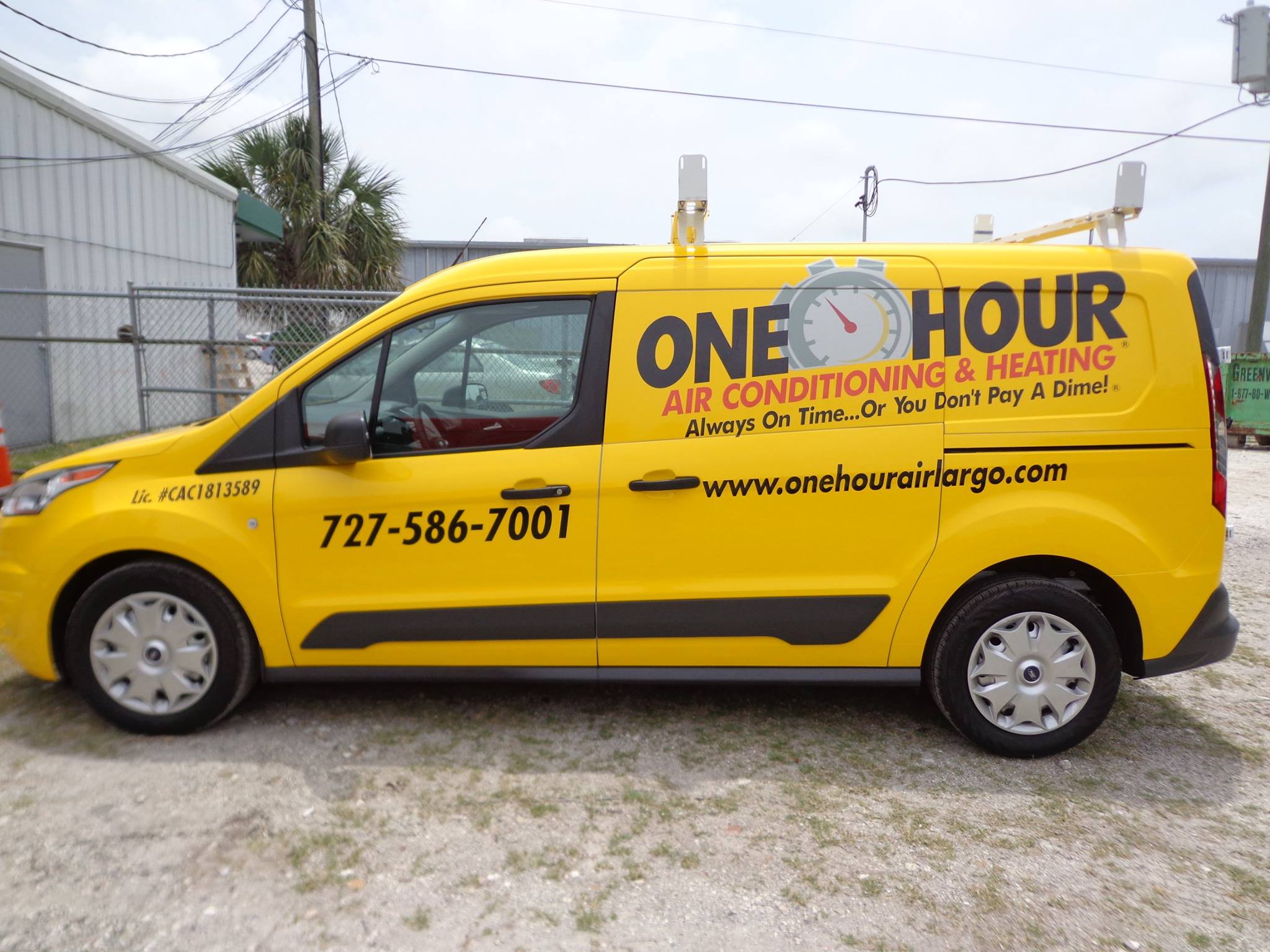
Contrast does more work than size. The One Hour Air van pictured above reads from across a lot because black type sits on a solid yellow panel with nothing behind it. A photographic background will beat any typeface you put on top of it.
Caring for a magnetic sign in Florida heat
DVC Signs qualifies the material with “when properly cared for,” and in Pinellas County that qualification carries weight. A parked steel door in August gets hot, and a magnetic sheet holds heat and moisture against it.
The failure mode is almost always the same. Grit and rainwater work under an edge, sit there in the heat, and start marking the paint. Then the sheet warps slightly, the edge lifts a little more, and the next drive on Roosevelt Boulevard finishes it.
What prevents it:
- Take the sign off regularly. Clean the back of the magnet and the panel underneath, then dry both before it goes back on. Weekly is a reasonable habit for a vehicle that works every day.
- Take it off before washing the vehicle. High pressure at an edge is the fastest way to lose one.
- Store it flat. Rolled or folded magnetic sheet keeps the shape it was left in, and a sheet that no longer sits flat no longer holds.
- Do not put it back over wet paint, wax residue or grit.
- Check the edges after long highway runs. Lift starts at a corner.
- Move it slightly when you refit it. Leaving it in the exact same footprint for months is what produces a visible outline, because the paint under it does not weather at the same rate as the paint around it.
Handled that way, a magnetic sign does the job it was bought for. Left on and forgotten for a year in Florida sun, it becomes a paint problem, which is the outcome the word “semi durable” is warning you about.
What to bring to DVC Signs in Largo
You will get a faster and more accurate quote with five things ready:
- The flat measurement. The usable rectangle on the door, in inches, clear of body lines, handles and trim.
- Year, make and model, and which panels. Both front doors, both rear quarters, the tailgate, or some combination.
- Your logo as vector artwork if you have it. Send whatever you have through the artwork upload page.
- The exact wording, spelled the way it has to appear. Business name, phone number, website, and any license or USDOT number that has to be on the vehicle.
- Whether it has to come off. This is the question that decides magnet against lettering, and it is worth answering honestly before you spend anything.
DVC Signs is at 12350 S. Belcher Rd., Suite 14-B, Largo, FL 33773, open Monday to Friday, 8:00am to 5:00pm, on (727) 524-8543. You can also start from the quote request form. Material details for magnetic and the other substrates are on the materials page. Pricing and lead times are quoted per job and are not published (to confirm).
Frequently asked questions
Will a magnetic sign stick to an aluminum truck door?
No. DVC Signs specifies magnetic material for steel surfaces. Aluminum, fiberglass and composite panels are not magnetic, and there is no adhesive backing to fall back on. Test the door with a household magnet before you order.
Can a magnetic sign meet the USDOT marking requirement?
49 CFR 390.21(d) states the marking may consist of a removable device provided it meets the identification and legibility requirements of paragraph (c), which are both sides of the vehicle and readily legible from 50 feet in daylight. Whether your operation is covered by the rule at all depends on 49 CFR 390.5 and, for intrastate work in Florida, on Florida Statutes 316.302. Confirm that with FMCSA or Florida commercial vehicle enforcement, not with a sign shop.
Can I leave the magnets on all the time?
DVC Signs calls the material semi durable and conditions it on proper care. Leaving it in place for months in Florida sun traps heat, water and grit against the paint and is the most common way these signs end badly. Take it off, clean both surfaces, dry them, and refit.
Will it come off on the highway?
Not if the whole sheet is on flat steel, the panel is clean and dry, and the edges are checked. It will if part of the sheet bridges a body line, a rivet or a molding, because that corner is not held down.
What should I use if the panel is not steel?
Cut vinyl lettering or see-thru window graphics. Window graphics are often the answer on a van whose side panels are ribbed or composite, since the glass is flat and available. Both are listed on the vehicle graphics page.
How large can a magnetic sign be?
DVC Signs describes the material as suited to smaller signs. In practice the limit is the flat steel you have, not the press. Larger areas are better served by lettering or partial graphics.
Sources
- DVC Signs, Materials, magnetic entry. Read 2026-09-30.
- DVC Signs, Vehicle Graphics, Wraps and Decals, applications list. Read 2026-09-30.
- 49 CFR 390.21, Marking of self-propelled CMVs and intermodal equipment, paragraphs (b), (c) and (d). Read 2026-09-30.
- 49 CFR 390.5, definition of commercial motor vehicle. Read 2026-09-30.
- Florida Statutes 316.302, Commercial motor vehicles; safety regulations; transporters and shippers of hazardous materials; enforcement. Read 2026-09-30.